

Whole Life vs Term Life Insurance | Compare Cost and Coverage
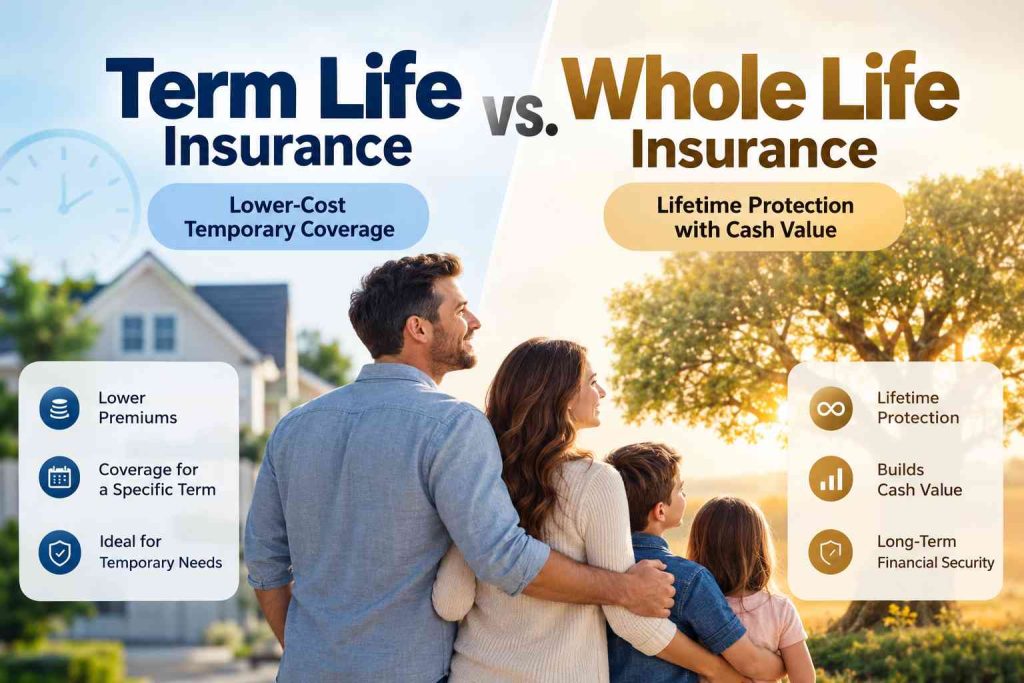
If two policies can provide the same death benefit today, why can one cost much more? That question sits at the center of whole life insurance vs term. The products are not priced differently because one company likes a bigger number. They are built to solve different timing problems. Term coverage is designed for a defined period. Whole life is designed for permanent protection and includes cash-value features.
A young family may need a large amount of protection while children are dependent and a mortgage is high. A different household may need a smaller benefit that stays in place for final expenses or a lifelong dependent. The right comparison is therefore not “Which policy is better?” It is “How long does this financial obligation last?”
Searches for term vs whole life insurance, whole life vs term life insurance, permanent vs term life insurance, and term vs permanent life insurance all point to that same decision. Duration comes first. Cost, cash value, and flexibility follow from it.

The Biggest Difference Is How Long Coverage Is Designed to Last
Term insurance is written for a stated coverage period or to a specified age, depending on the product. If the insured dies while the coverage is in force, the policy can pay the death benefit subject to its terms. If the term ends and coverage is not renewed, converted, or replaced, the protection ends.
That structure fits temporary financial risks. A parent may want 25 years of income replacement while children grow up. A homeowner may want coverage while a mortgage is large. A business owner may need temporary protection tied to a loan or transition period.
Whole life addresses a different duration. It is designed to stay in force for life when required premiums are paid and policy terms are met. That can make sense when the need itself does not disappear. The key is to identify the need before choosing the policy. Buying permanent coverage for a temporary problem can create unnecessary cost, while buying only temporary coverage for a lifelong obligation can create a gap later.
Why Term Usually Starts With a Lower Premium
Term usually starts with a lower premium because it is providing death-benefit protection for a limited period and most policies do not build cash value. The insurer is not promising the same lifetime structure found in permanent coverage. That allows a healthy younger applicant to often purchase a larger death benefit for a given premium.
The lower starting cost can be extremely useful. A family in its thirties may need substantial protection but also has childcare, housing, and retirement contributions competing for cash. Term can allow that family to cover a large temporary risk without committing as much money to insurance.
However, lower initial cost does not mean term is always cheaper in every future scenario. Renewal premiums can rise, and buying new coverage at an older age may cost more or require new underwriting. The important comparison is the period you actually need coverage, not a slogan about which product is cheaper.
A simple family example shows why the answer can be mixed. Suppose parents in their mid-thirties need $1 million of protection while two children are dependent, but they also want $75,000 that will remain for final expenses and a small legacy. Buying $1 million of whole life may create a premium they do not want to carry. Buying only a 20-year term policy may leave the permanent goal uncovered. A layered plan can use term for the large temporary exposure and whole life for the smaller lifelong need. The point is not that everyone should layer policies. It is that the coverage duration can be matched to separate financial obligations rather than forcing one product to do everything.
What Whole Life Adds Beyond Temporary Coverage
Whole life adds a permanent structure and cash value. Traditional policies usually emphasize scheduled premiums, guaranteed values, and a death benefit intended to remain in force for life. Participating policies may also pay dividends, but dividends are not guaranteed.
Those features explain much of the higher premium commitment. The owner is not only buying a death benefit for the next 20 years. The contract is built around protection that can continue much longer and around values that develop inside the policy.
That can be useful for final expenses, legacy goals, lifelong dependent support, or people who strongly value predictable permanent coverage. It can also be unnecessary if the real need ends at retirement and the higher premium reduces emergency savings or retirement contributions. Whole life should earn its place in the plan by solving a permanent problem.

Which Financial Need Are You Trying to Cover?
Think about two households. Household A has two children under ten, a large mortgage, and a primary earner whose income supports nearly every monthly bill. Their biggest risk is losing that income during the next 20 years. A large term policy may match that temporary exposure well.
Household B has an adult child with lifelong support needs. The parents want a benefit that does not disappear when they reach a certain age. They may still use term coverage for temporary income protection, but permanent coverage is more relevant to the lifelong obligation.
Neither household proves that one policy is universally better. They show why purpose controls the decision. The amount, duration, budget, health, and future insurability all matter. A useful insurance plan is built around specific liabilities and people, not around winning an argument between products.
When quotes arrive, compare coverage first and premium second. A $1 million term policy and a $200,000 whole-life policy are not equivalent simply because the premiums are similar. Write down the death benefit, the years of protection needed, the premium period, and whether cash value matters. Then ask what happens when the term ends or when the whole-life premium becomes difficult. This keeps the comparison honest. The policy with the more attractive feature list may not be the one that closes the family’s biggest financial gap.
Can You Use Both?
Yes, term and whole life can be used together. Layering is often more practical than forcing every need into one policy. A family might use term coverage for the large temporary income-replacement need and keep a smaller whole-life policy for a permanent legacy or final-expense goal.
The layers can also change over time. As children become independent and debt falls, temporary coverage may decline. Permanent coverage may remain because its purpose has not changed. The strategy should be reviewed when income, debt, family structure, business ownership, or estate goals change.
MM4I can help compare the two structures on the same page: coverage amount, duration, premium, guarantees, cash value, and what happens at the end of the term. That makes the trade-off visible. The goal is not to choose a winner. It is to give each financial need the type of coverage that fits its timeline.
One final check is future insurability. A term policy may include conversion rights that allow some coverage to be converted to permanent insurance without new medical underwriting, but those rights are policy-specific and can expire. If conversion matters, verify the deadline and available products before buying. That feature can be valuable, but it should not be assumed.
Frequently Asked Questions
Is whole life insurance better than term life insurance?
Neither is universally better. Term often fits temporary income-replacement needs at a lower initial premium, while whole life may fit permanent needs and buyers who value cash value and contractual predictability.
Why is term life insurance usually cheaper?
Term is usually designed for a limited period and generally does not include cash value. Because the insurer is not providing the same permanent structure, initial premiums can be lower for comparable death benefits.
Can I own term and whole life insurance at the same time?
Yes. Many people layer coverage, using term for a large temporary need and a smaller permanent policy for lifelong goals. The combination should still fit the total budget and coverage need.
Match the Coverage Timeline to the Financial Timeline
The most useful whole-life-versus-term decision starts with one question: when does the financial need end? Once that is clear, the difference in premium, cash value, and guarantees becomes easier to judge.
MM4I can help compare both designs without forcing the entire plan into one product. A temporary obligation and a permanent obligation do not have to be insured the same way. The strongest plan is the one that gives each need the right amount of protection for the right length of time.