

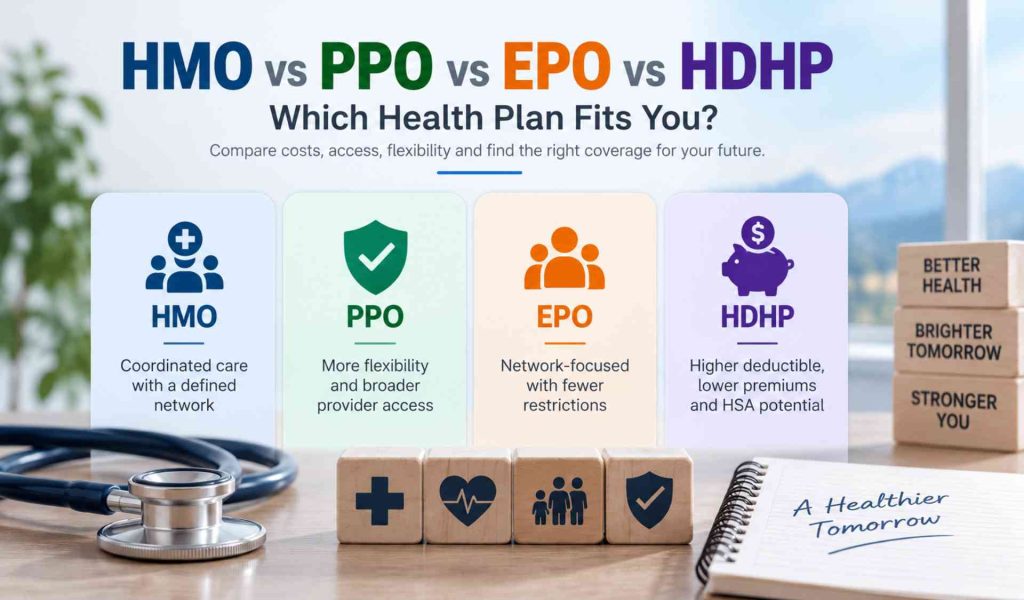
HMO vs PPO vs EPO vs HDHP: Which Fits You?
Choosing among health insurance plans is rarely just a matter of finding the lowest monthly premium. For professionals approaching retirement, running businesses, or managing substantial household finances, the more important question is how a plan distributes healthcare costs, provider flexibility, and financial risk.
The USHealthCosts audit provides a useful starting point: compare insurance according to practical consequences rather than technical labels. It specifically identifies four structures and recommends considering premiums, deductibles, networks, expected healthcare use, HSA compatibility, and risk tolerance together. This changes the question completely.
A Health Maintenance Organization (HMO) coordinates care through a defined network, generally limiting non-emergency out-of-network coverage.
Shorthand for Preferred Provider Organization, PPO provides broader provider flexibility, covering out-of-network care while usually charging higher costs.
An Exclusive Provider Organization (EPO) generally requires in-network providers, except during emergencies, while avoiding many referral requirements.
The so-called HDHP, which stands for High-Deductible Health Plan, is a health insurance plan with higher deductibles and lower premiums. It may qualify users for tax-advantaged Health Savings Accounts.
The Four Plans Are Not Four Versions of the Same Thing
First, an important clarification matters.
HMO, PPO, and EPO describe different approaches to provider networks and access. An HDHP, or high-deductible health plan, describes a plan with a higher deductible structure and can also be combined with another network design. Therefore, an HDHP is not always a completely separate network category.
HealthCare.gov describes an HMO as generally limiting coverage to its network except for emergencies, while a PPO generally permits out-of-network care at additional cost. An EPO generally covers care only through its network except for emergencies.
That distinction matters when comparing health insurance plans accurately.
What Actually Separates HMO, PPO, EPO, And HDHP?
The practical differences become clearer when the plans are viewed through financial exposure and access.
| Plan structure | Provider flexibility | Out-of-network coverage | Typical financial emphasis |
| HMO | More restricted | Usually unavailable except emergencies | Coordinated care |
| PPO | Greater flexibility | Generally available at higher cost | Access and flexibility |
| EPO | Network-focused | Generally unavailable except emergencies | Network efficiency |
| HDHP | Depends on underlying network | Depends on underlying plan | Higher deductible, lower premium potential, HSA opportunity |
HealthCare.gov confirms that Marketplace plans can include HMO, PPO, and EPO structures across different metal tiers.
The important point is simple. The label does not determine the entire cost.
Instead, the specific contract does.
PPO: Is Flexibility Worth Paying More?
A PPO health insurance plan can appeal to someone who values provider choice.
PPOs generally allow members to use in-network providers at lower cost while permitting out-of-network care without requiring a primary-care referral. The trade-off is that out-of-network services generally cost more.
For a professional who regularly travels, maintains relationships with particular specialists, or wants greater provider flexibility, that distinction can matter considerably.
However, flexibility should be valued according to actual need.
Paying substantially more for a PPO makes less sense when the preferred doctors, hospitals, and specialists are already available within a lower-cost network.
KFF’s 2025 employer survey found PPOs remained the most common plan type among covered workers, accounting for 46% of enrollment. It also found average annual premiums for PPO coverage were higher than overall employer-plan averages.
This does not make PPO coverage automatically better. It makes flexibility a feature that should be priced.
HMO: Can Coordination Reduce Unnecessary Complexity?
An HMO health insurance plan generally emphasizes coordinated care through a defined provider network.
The model can work well for someone whose preferred physicians and hospitals participate in the network and who does not require extensive out-of-network access.
The financial attraction can be meaningful.
HealthCare.gov explains that HMOs generally do not cover non-emergency out-of-network care. KFF’s 2025 data also show that 47% of covered workers in HMOs had no general annual deductible for single coverage, compared with 12% of PPO enrollees.
That does not establish that every HMO has lower costs.
Plan-specific benefits still determine the actual economics.
EPO: Is A Narrower Network an Acceptable Trade-Off?
An EPO health insurance plan occupies an interesting position.
It can offer network-focused coverage without the same out-of-network flexibility associated with a PPO. HealthCare.gov describes an EPO as generally covering services only when the member uses doctors, specialists, or hospitals within the plan’s network, except during emergencies.
For someone comfortable with a particular healthcare system, this arrangement may be perfectly workable.
For someone who travels extensively or wants access to specific specialists outside the network, it may create unacceptable limitations.
The network should therefore be examined before the premium.
HDHP: Can Higher Deductibles Make Financial Sense?
A high-deductible health plan, or HDHP, shifts more initial medical spending toward the insured.
That can potentially accompany lower premiums and, when the plan meets federal requirements, eligibility for a Health Savings Account.
KFF reported that 33% of covered workers were enrolled in HDHPs with a savings option in 2025. Average annual premiums for HSA-qualified HDHP coverage were $8,575 for single coverage and $25,303 for family coverage.
The attraction is not simply the premium.
An HSA-qualified arrangement can introduce another financial dimension because eligible healthcare expenses can be paid using tax-advantaged HSA funds.
But higher deductibles require financial capacity.
Someone with substantial liquid reserves may tolerate a large deductible more comfortably than someone whose household budget depends heavily on predictable monthly expenses.
The Real Comparison Is Financial Risk
The strongest lesson from the USHealthCosts framework is that health insurance costs should not be reduced to premiums.
A better comparison considers:
- Monthly or annual premium
- Deductible
- Copayments
- Coinsurance
- Out-of-pocket maximum
- Provider network
- Prescription formulary
- Expected medical utilization
- HSA eligibility
- Out-of-network exposure
That produces a more realistic question.
What financial exposure does this plan create?
KFF reported that the average deductible among covered workers with a general single-coverage deductible reached $1,886 in 2025. Among plans with deductibles, the average was $1,649 for HMOs, $1,337 for PPOs, and $2,609 for HDHPs with a savings option.
Those figures are employer-plan averages, not quotations for an individual. This distinction matters.
Your Healthcare Pattern Should Drive the Decision
The best health insurance plan depends partly on expected healthcare utilization.
Consider anticipated:
- Primary-care visits
- Specialist consultations
- Prescription medications
- Planned procedures
- Ongoing treatment
- Hospitalization risk
- Preferred physicians
- Preferred hospitals
The USHealthCosts audit specifically recommends starting with expected healthcare use and then evaluating potential annual cost, provider availability, and risk tolerance.
This is a better strategy than asking which plan is universally best.
There is no universally best plan.
A Financially Successful Person Still Has Risk Preferences
A high-income professional may be able to absorb a $5,000 unexpected medical bill without disrupting household finances.
This does not mean the person necessarily wants that exposure.
Financial capacity and risk preference are different concepts.
Someone may willingly pay higher premiums for greater predictability. Another person may prefer lower premiums while retaining enough liquid assets to absorb higher initial medical expenses.
The right decision therefore depends on both risk capacity and risk tolerance.
Do Not Forget the Provider Network
A seemingly inexpensive plan can become expensive if the preferred doctor or hospital is outside its network.
USHealthCosts specifically treats provider networks as a financial variable and recommends verifying network participation because directories can become outdated.
Before selecting among health insurance plans, verify:
- Primary-care physicians
- Preferred specialists
- Major hospitals
- Local urgent-care facilities
- Pharmacies
- Prescription coverage
Network compatibility can outweigh a modest premium difference.
So Which Plan Fits Best?
The answer depends on what the household is trying to optimize.
| Priority | Potentially attractive structure |
| Coordinated in-network care | HMO |
| Broader provider flexibility | PPO |
| Strong network discipline | EPO |
| Lower premium potential and HSA strategy | HDHP |
| Frequent out-of-network care | PPO may warrant closer consideration |
| Strong ability to absorb upfront costs | HDHP may warrant consideration |
These are decision starting points, not universal recommendations.
The Smarter Question to Ask
Instead of “Which health plan is best?” ask: Which combination of cost, access, flexibility, and risk fits the household?
This question captures the central insight from the USHealthCosts audit. Effective insurance content should translate technical plan structures into financial consequences, realistic scenarios, and informed decisions.
For professionals between 45 and 55, that perspective becomes particularly valuable. Healthcare decisions increasingly intersect with retirement preparation, business transitions, family obligations, liquidity, and long-term financial planning.
The objective is not merely to buy insurance.
It is to choose a structure whose financial trade-offs remain manageable when healthcare needs change.
Notice and Disclaimer
This article provides general educational information, not individualized insurance, financial, medical, or tax advice. Plan availability, premiums, networks, deductibles, benefits, and HSA eligibility vary by location and circumstances. Verify current terms with insurers, official marketplaces, and qualified professionals.