

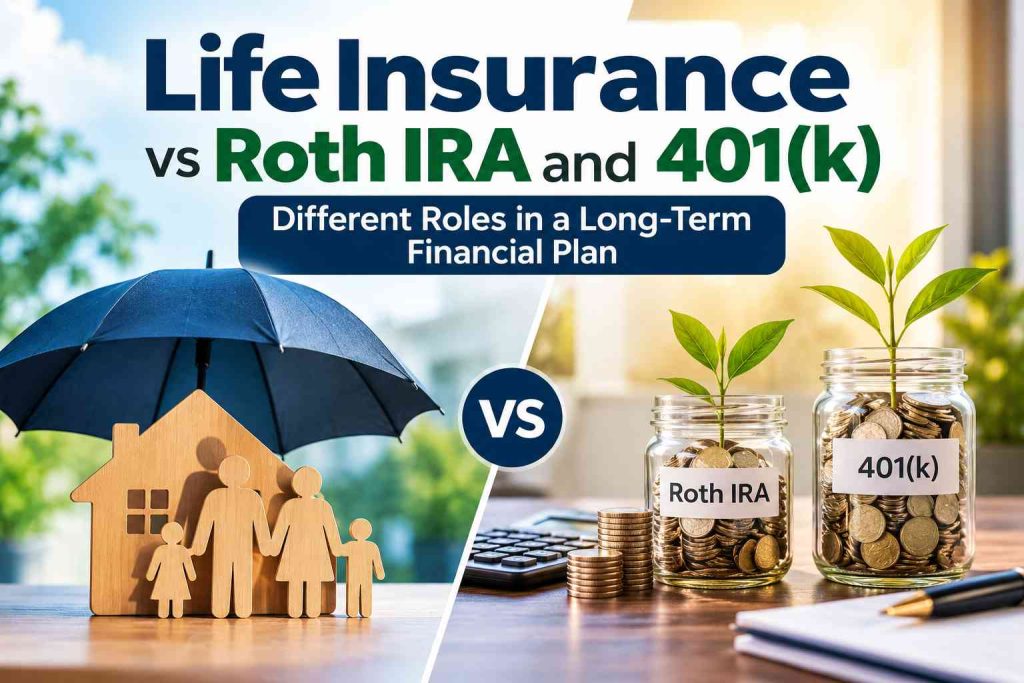
Life Insurance vs Roth IRA and 401(k) | Different Financial Roles
A retirement account and a permanent life insurance policy can both hold value for many years, but they were created to solve different problems. That is the most important point in life insurance vs Roth IRA and life insurance vs 401k comparisons. A Roth IRA or 401(k) is primarily a retirement account. Permanent life insurance is primarily insurance.
The confusion usually starts when permanent life insurance cash value is presented as a retirement strategy. Cash value can be accessed under policy rules, but that does not automatically make it a substitute for retirement accounts. Contributions, taxes, investment choices, fees, liquidity, and insurance costs all work differently.
A strong financial plan can use several tools at once. Protection, emergency savings, retirement investing, and legacy planning are separate jobs. The useful question is not which account wins. It is which job each dollar needs to perform.

Roth IRAs and 401(k)s Are Retirement Accounts
Roth IRAs and 401(k)s are retirement vehicles. They allow eligible contributions under tax rules and typically hold investments selected according to the plan or account. A 401(k) may also include employer contributions, depending on the plan. A Roth IRA uses after-tax contributions and can provide tax-free qualified distributions when rules are met.
Those accounts do not provide a life-insurance death benefit in the same way a policy does. Their main purpose is to accumulate assets for retirement. Market value can rise or fall depending on investments.
That purpose should remain clear. Someone who is behind on retirement saving should understand what is being given up before redirecting contributions into another product.
Permanent Life Insurance Is Primarily Insurance
Permanent life insurance starts with a death benefit. Whole life insurance cash value or other permanent cash value is a feature inside that insurance contract. Premiums support the cost of insurance, expenses, guarantees, and policy values.
The policy can provide protection immediately after it is in force, subject to contract terms, while cash value develops over time. That is fundamentally different from a retirement account funded only with the owner’s contributions and investment results.
Permanent coverage can have a role in legacy planning, lifelong dependent support, final expenses, or other long-duration insurance needs. It should not be purchased solely because a projected cash-value column resembles a retirement chart.
A useful planning exercise is to label four buckets: emergency savings, retirement accounts, life insurance, and legacy assets. Then ask what happens if one bucket is missing. Without emergency savings, a family may need to borrow for short-term problems. Without retirement saving, future income may depend too heavily on Social Security or other sources. Without enough life insurance, survivors may face a sudden financial gap. The exercise shows why redirecting every available dollar into one product can weaken the overall plan even when that product has attractive features.
Tax Treatment Works Differently
Tax treatment is different and more nuanced than simple marketing phrases suggest. Roth contributions are made with after-tax dollars, and qualified Roth distributions can be tax-free under current law. Traditional 401(k) contributions and distributions follow different rules. Contribution limits, required distributions, plan rules, and penalties can also apply.
Life-insurance death benefits are generally received income-tax-free by beneficiaries under federal rules, but exceptions exist. Cash-value withdrawals, surrenders, loans, modified endowment contract status, and policy lapse can produce different tax outcomes.
That is why “tax-free retirement income” should never be treated as a universal promise for life insurance. Tax planning depends on how the policy is designed and used, as well as current law.

Liquidity, Fees, and Access Are Different
Liquidity and costs also differ. Retirement accounts can have restrictions or tax consequences for certain early withdrawals, but the assets are still held in an account designed for retirement investment. A permanent policy may allow loans or withdrawals, but those actions can reduce cash value or death benefits and can create loan interest.
Insurance policies also contain mortality costs, expenses, and potentially surrender charges. Retirement accounts can have investment expenses and plan fees instead. The cost structures should be compared honestly rather than assuming one is “free.”
The right choice depends on what the money is meant to accomplish and when it may be needed.
Before redirecting retirement contributions to an insurance premium, calculate what will happen to employer matching, tax-advantaged contribution room, emergency savings, and the total death-benefit need. The comparison should use the entire financial plan, not only a projected cash-value chart. If a permanent policy is still appropriate, size it so the household can continue funding other priorities. This does not mean retirement accounts always come first for every person. It means the trade-off should be explicit. A dollar cannot fund two goals at the same time, so the owner should know which goal each dollar is serving.
Use the Right Tool for Each Goal
Use the right tool for each goal. Emergency cash should remain accessible. Retirement accounts should be evaluated for retirement accumulation and tax advantages. Life insurance should be evaluated for the financial risk of death. Legacy goals can involve insurance, investments, estate planning, or a combination.
A person can reasonably own a 401(k), Roth IRA, savings account, and permanent life insurance at the same time. The presence of one does not make the others unnecessary.
MM4I can help place permanent life insurance in context instead of presenting it as a replacement for every financial account. The strongest plan gives each tool a defined job and understands the trade-offs before moving money from one priority to another.
Employer benefits deserve special attention in a 401(k) comparison. If an employer matches employee contributions, reducing contributions can mean giving up compensation that would otherwise go into the retirement plan. That does not automatically prohibit buying permanent insurance, but it changes the trade-off. The buyer should calculate the effect before redirecting cash. Roth IRA eligibility and contribution rules can also change with tax law and income. Because these are tax-advantaged retirement accounts, current IRS rules should be checked rather than relying on an old article or a sales illustration.
Fees should be compared in the form each product actually uses. Retirement accounts may show expense ratios, plan fees, or advisory costs. Life insurance may use mortality charges, expenses, rider charges, and surrender costs that are reflected differently. Comparing only one visible fee from each product can create a false impression of cost.
A retirement comparison should also include time horizon. Someone decades from retirement can usually tolerate a very different investment mix than someone five years away. Life insurance does not remove market risk from the rest of the plan, and retirement accounts do not remove the need for protection. Coordinating the two is more useful than asking one product to substitute for the other.
The current tax limits also show why these accounts should not be treated casually. For 2026, the IRS lists a $7,500 annual contribution limit for traditional and Roth IRAs, with a higher limit for eligible people age 50 or older, and a $24,500 basic elective-deferral limit for most 401(k) plans. Those limits can change from year to year, and Roth IRA eligibility can also depend on income. A permanent life insurance premium is not the same kind of tax-advantaged contribution. When comparing where new dollars should go, use the current retirement-plan rules and the household’s insurance need rather than comparing only projected account values.
Frequently Asked Questions
Is life insurance a substitute for a Roth IRA?
Generally, no. A Roth IRA is a retirement account, while life insurance is primarily protection against the financial consequences of death. They have different tax rules, costs, liquidity, and purposes.
Can whole life cash value be used in retirement?
Potentially, depending on the policy. Cash value may be accessed through loans or withdrawals, but those actions can affect values, benefits, policy stability, and taxes. It should be reviewed carefully.
How is a 401(k) different from permanent life insurance?
A 401(k) is an employer-sponsored retirement plan with contribution and tax rules. Permanent life insurance is an insurance contract with a death benefit and possible cash value. They solve different financial problems.
Do Not Ask One Product to Replace an Entire Financial Plan
Retirement accounts, savings, and life insurance can all be useful because they do different work. Problems arise when a product is sold as a universal replacement for the others.
MM4I can help evaluate permanent coverage in the context of retirement saving and liquidity needs. Protection should strengthen the plan, not quietly displace another priority without a clear reason.