

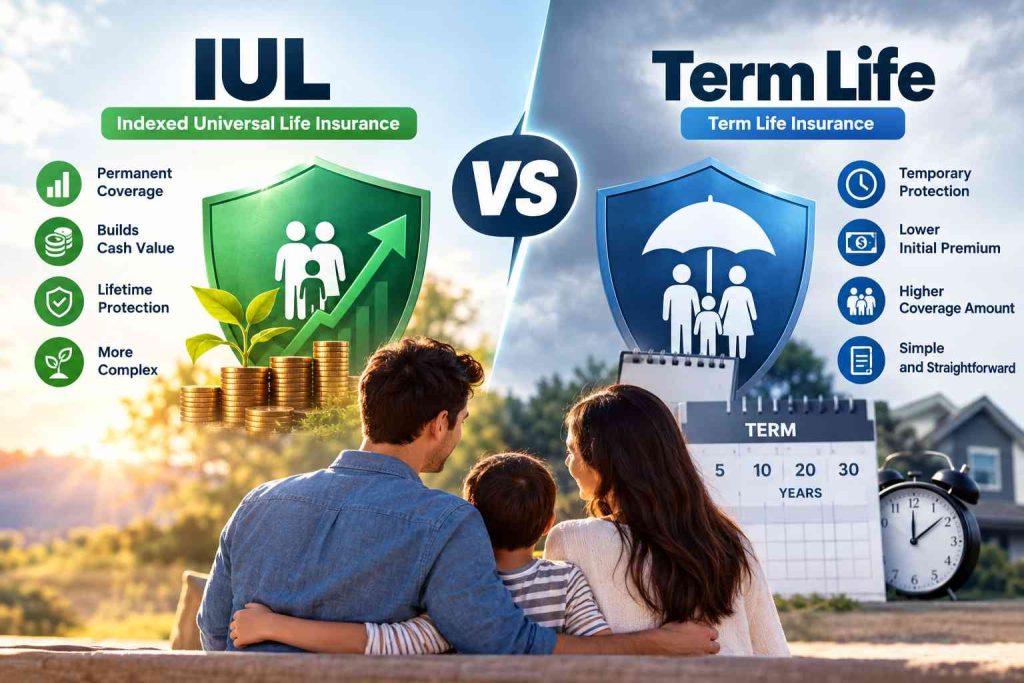
IUL vs Term Life Insurance | Permanent Cash Value or Temporary Protection
A young family can often buy a much larger term life insurance death benefit for the same initial premium that might support a smaller permanent policy. So why would someone compare IUL vs term life insurance at all? Because the policies are built for different jobs. Term is designed around temporary protection. Indexed universal life insurance is designed around permanent coverage with cash-value mechanics.
The decision should start with the financial problem, not with the most interesting product feature. A couple raising children may need a large amount of income replacement for 20 or 30 years. That same couple may also want a smaller permanent benefit for a lifelong goal.
IUL vs term becomes useful when the buyer separates those needs. One product may be better suited to a temporary risk, while the other may be relevant to a permanent obligation. Sometimes the most practical answer is not one policy or the other, but a combination.

Term Life Solves a Temporary Protection Problem
Term life insurance is usually straightforward. The policy provides a death benefit for a stated term or to a stated age, depending on the contract. If the insured dies while coverage is in force, beneficiaries may receive the death benefit subject to policy terms. Most term policies do not build cash value.
That simplicity makes term useful for large temporary needs. Income replacement while children are dependent, a mortgage, education funding, or a business obligation can all have a clear end point.
Because term does not include the same permanent cash-value structure, initial premiums can be lower for a comparable death benefit, especially for younger healthy applicants. That can make it easier to buy enough protection when the financial exposure is at its highest.
IUL Combines Permanent Coverage With Cash-Value Mechanics
Indexed universal life insurance is a form of permanent coverage. It combines a death benefit with cash value and an index-linked crediting method. Premium flexibility, policy charges, caps, participation rates, spreads, and other contract features make it more complex than typical term insurance.
The permanent structure can fit a lifelong need, but the cash-value component should not distract from the insurance purpose. The policy must be adequately funded, and projected values are not guarantees.
A buyer who wants permanent coverage and is comfortable monitoring the policy may find IUL worth comparing. A buyer who only needs 20 years of protection may be paying for features that do not match the problem.
Consider parents with a newborn, a $500,000 mortgage, and one primary earner. Their immediate concern is replacing income for the next 25 years. If the budget can support either $1 million of term coverage or only $250,000 of IUL coverage, choosing the smaller permanent policy simply because it builds cash value could leave a large protection gap. The family might instead use term for the large temporary need and add a smaller permanent layer if a lifelong goal exists. The example shows why death-benefit adequacy should be tested before cash-value features are compared.
Premium Commitment and Coverage Amount Can Be Very Different
Premium commitment and coverage amount can differ dramatically between the two products. Term often allows a household to buy a larger death benefit for a lower initial premium. IUL generally requires more premium because it is designed for permanent protection and includes cash-value mechanics.
This does not mean term is always the cheaper lifetime solution or that IUL is always expensive. Renewal costs, conversion rights, future insurability, policy funding, and coverage duration all matter.
The practical comparison should use the amount of death benefit actually needed. If a family needs $1 million of protection during the child-raising years, a smaller permanent policy should not be treated as an equivalent substitute simply because it builds cash value. Protection amount comes before cash-value appeal.

Temporary Need vs. Lifelong Need
Term vs permanent life insurance is fundamentally a timing decision. A mortgage may end. Children may become independent. Income replacement may no longer be needed after retirement. Those are temporary risks.
Other needs can be lifelong. A dependent may require support indefinitely. A family may want final-expense coverage or a guaranteed legacy regardless of age at death. Certain estate or business needs may also remain.
The more permanent the obligation, the more relevant a permanent policy becomes. The more temporary the obligation, the stronger the case for term. The purpose should decide the duration before the buyer compares product illustrations.
When a family is comparing IUL and term, calculate the protection gap before discussing cash value. Estimate income replacement, mortgage, childcare, education, and other temporary obligations. Then see how much death benefit each premium can actually purchase. If permanent coverage is also desired, price that need separately. This method prevents the permanent product from consuming the budget needed for adequate temporary protection. It also lets the family decide whether a smaller permanent layer belongs in the plan without sacrificing the amount of coverage needed during the highest-risk years.
Some People Use Both
Some households use both. A large term policy can cover the temporary high-risk years, while a smaller IUL or another permanent policy can address a lifelong goal. This can reduce the permanent premium commitment without leaving every need dependent on term coverage.
Layering also makes future reviews easier. As temporary obligations fall, term coverage can be allowed to expire or be adjusted according to policy options. The permanent layer remains tied to the need that did not change.
MM4I can help compare IUL vs term by separating coverage amount, duration, premium, and policy complexity. A good plan does not ask one policy to solve every problem. It assigns the right type of protection to each timeline.
Future conversion options can matter for young families. Some term policies allow conversion to a permanent product without new medical underwriting during a stated period, but the available products, deadlines, and conversion rules vary. A family that cannot afford much permanent coverage today may value that option, especially if health changes later. The feature should be verified in the actual term contract rather than assumed. Conversion does not automatically make term equivalent to IUL, but it can add flexibility to a protection-first strategy.
A family should revisit the mix every few years. As debt falls and children become independent, the temporary need may shrink. If permanent coverage was purchased, its purpose should still be checked. Layering works best when each layer is allowed to change with the need it was designed to cover.
Protection planning should also account for what happens if the insured becomes less healthy later. Term conversion features may provide one path, while existing permanent coverage already avoids the need to requalify for that amount. The value of future insurability is real, but it should be weighed against today’s premium rather than used as a reason to underinsure the family now.
The decision should also be revisited as the family’s needs change. A 30-year mortgage may disappear, children may become financially independent, or a permanent legacy goal may become more important. Term life insurance can address the high temporary need, while indexed universal life insurance may be considered separately for a lifelong objective. Keeping those goals separate helps prevent a buyer from paying for permanent features when the real need is temporary, or relying on temporary coverage for a lifelong obligation.
Frequently Asked Questions
Is IUL more expensive than term life insurance?
Usually, IUL requires a higher premium commitment because it is designed for permanent coverage and includes cash-value mechanics. Term is generally lower-cost initially for comparable death benefits, especially at younger ages.
Does term life insurance build cash value?
Most term life insurance does not build cash value. Its primary job is to provide a death benefit during the stated coverage period.
Can I own term insurance and IUL at the same time?
Yes. Some people use term coverage for a large temporary need and a smaller IUL or other permanent policy for lifelong goals. The combined premium should still fit the budget.
Do Not Trade Away Needed Protection for a More Interesting Product
The first job of life insurance is to cover the financial risk. If a family needs a large death benefit for 25 years, that need should not be reduced simply to make room for a cash-value feature. If a lifelong obligation also exists, permanent coverage can be considered separately.
MM4I can help map temporary and permanent needs before comparing policies. That keeps the decision focused on protection first and product features second.